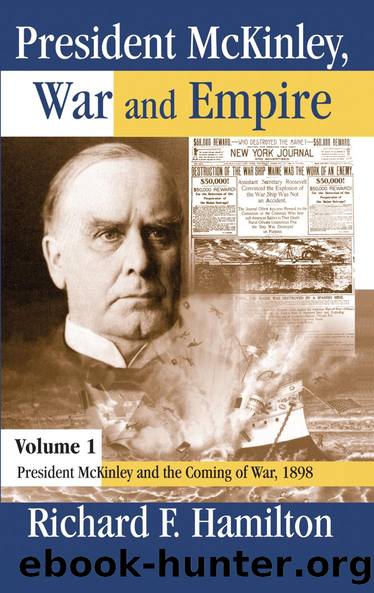
President McKinley, War and Empire by Richard F. Hamilton
Author:Richard F. Hamilton [Hamilton, Richard F.]
Language: eng
Format: epub
Tags: History, Americas (North; Central; South; West Indies), Political Science, General
ISBN: 9781351496964
Google: 2SwrDwAAQBAJ
Publisher: Routledge
Published: 2017-07-05T01:30:09+00:00
Notes
* * *
1. For accounts of the war see the following: Walter Millis, The Martial Spirit: A Study of Our War with Spain (New York, 1965 [1931]); Julius W. Pratt, Expansionists of 1898: The Acquisition of Hawaii and the Spanish Islands (Chicago, 1964 [1936]); Ernest R. May, Imperial Democracy: The Emergence of America as a Great Power (New York, 1961); Walter LaFeber, The New Empire: An Interpretation of American Expansion, 1860â1898 (Ithaca, 1963); Walter LaFeber, The American Search for Opportunity, Vol. 2 of The Cambridge History of American Foreign Relations (Cambridge, 1993); Howard Wayne Morgan, Americaâs Road to Empire: The War with Spain and Overseas Expansion (New York, 1965); John A. S. Grenville and George Berkeley Young, Politics, Strategy, and American Diplomacy: Studies in Foreign Policy, 1873â1917 (New Haven, 1966); Hugh Thomas, Cuba: The Pursuit of Freedom (New York, 1971); Philip S. Foner, The Spanish-Cuban-American War and the Birth of American Imperialism 1895â1902, two volumes (New York, 1972); Gerald F. Linderman, The Mirror of War: American Society and the Spanish-American War (Ann Arbor, 1974); Charles S. Campbell, The Transformation of American Foreign Relations, 1865â1900 (New York, 1976); David F. Trask, The War with Spain in 1898 (New York, 1981); Louis A. Pérez, Jr., Cuba between Empires 1878â1902 (Pittsburgh, 1982); Louis A. Pérez, Jr., Cuba and the United States: Ties of Singular Intimacy (Athens, GA, 1990); John L. Offner, An Unwanted War: The Diplomacy of the United States and Spain over Cuba, 1895â1898 (Chapel Hill, 1992); and Ivan Musicant, Empire by Default: The Spanish-American War and the Dawn of the American Century (New York, 1998). For a recent brief summary, see Offner, âMcKinley and the Spanish-American War,â Presidential Studies Quarterly, 34 (2004):50â61.
2. For more extended overviews, see Campbell, Transformation; Grenville and Young, Politics, Strategy; and Thomas, Cuba. Cubanâs history was one of âchronic rebellion,â something that troubled American leaders. From an early point, some American leaders favored annexation; some sharply opposed that option. In 1895, just prior to the Cuban revolution, the United States was involved in the Venezuela boundary dispute. The policies of President Cleveland and Secretary of State Olney brought the nation onto a collision course with Great Britain. It was a prelude to the subsequent drama, an episode that showed the demagogic possibilities of foreign affairs, one that aroused the âjingoes.â See May, Imperial Democracy, p. 33 and Grenville and Young, Politics, Strategy, chs. 5 and 6.
3. Offner, Unwanted War, p. 5.
4. Campbell, Transformation, p. 242. In 1869, in the earlier liberation struggle, Carlos Céspedes, the nominal chief of the Cuban rebels, announced the plan to destroy the sugar plantations. His words: âBetter . . . that Cuba should be free even if we have to burn every vestige of civilizationâ (Thomas, Cuba, p. 255). On events in 1895 and after, see his pp. 321â333.
5. Edwin F. Atkins, Sixty Years in Cuba (Cambridge, 1926), pp. 77.
6. Ibid., pp. 143â144. Atkins blamed the United States Congress for its shortsightedness; the new tariff halted and reversed the recent economic development and created the conditions that led to revolution and the subsequent war.
Download
This site does not store any files on its server. We only index and link to content provided by other sites. Please contact the content providers to delete copyright contents if any and email us, we'll remove relevant links or contents immediately.
The Vikings: Conquering England, France, and Ireland by Wernick Robert(84384)
Ali Pasha, Lion of Ioannina by Eugenia Russell & Eugenia Russell(40321)
The Conquerors (The Winning of America Series Book 3) by Eckert Allan W(37986)
The Vikings: Discoverers of a New World by Wernick Robert(37007)
Cecilia; Or, Memoirs of an Heiress — Volume 1 by Fanny Burney(32638)
Cecilia; Or, Memoirs of an Heiress — Volume 2 by Fanny Burney(32013)
Cecilia; Or, Memoirs of an Heiress — Volume 3 by Fanny Burney(31997)
Empire of the Sikhs by Patwant Singh(23137)
The Secret History by Donna Tartt(19311)
Hans Sturm: A Soldier's Odyssey on the Eastern Front by Gordon Williamson(18652)
Cat's cradle by Kurt Vonnegut(15446)
Pimp by Iceberg Slim(14685)
Sapiens: A Brief History of Humankind by Yuval Noah Harari(14465)
Norse Mythology by Gaiman Neil(13459)
Talking to Strangers by Malcolm Gladwell(13445)
Leonardo da Vinci by Walter Isaacson(13413)
4 3 2 1: A Novel by Paul Auster(12520)
Underground: A Human History of the Worlds Beneath Our Feet by Will Hunt(12148)
The Radium Girls by Kate Moore(12096)
